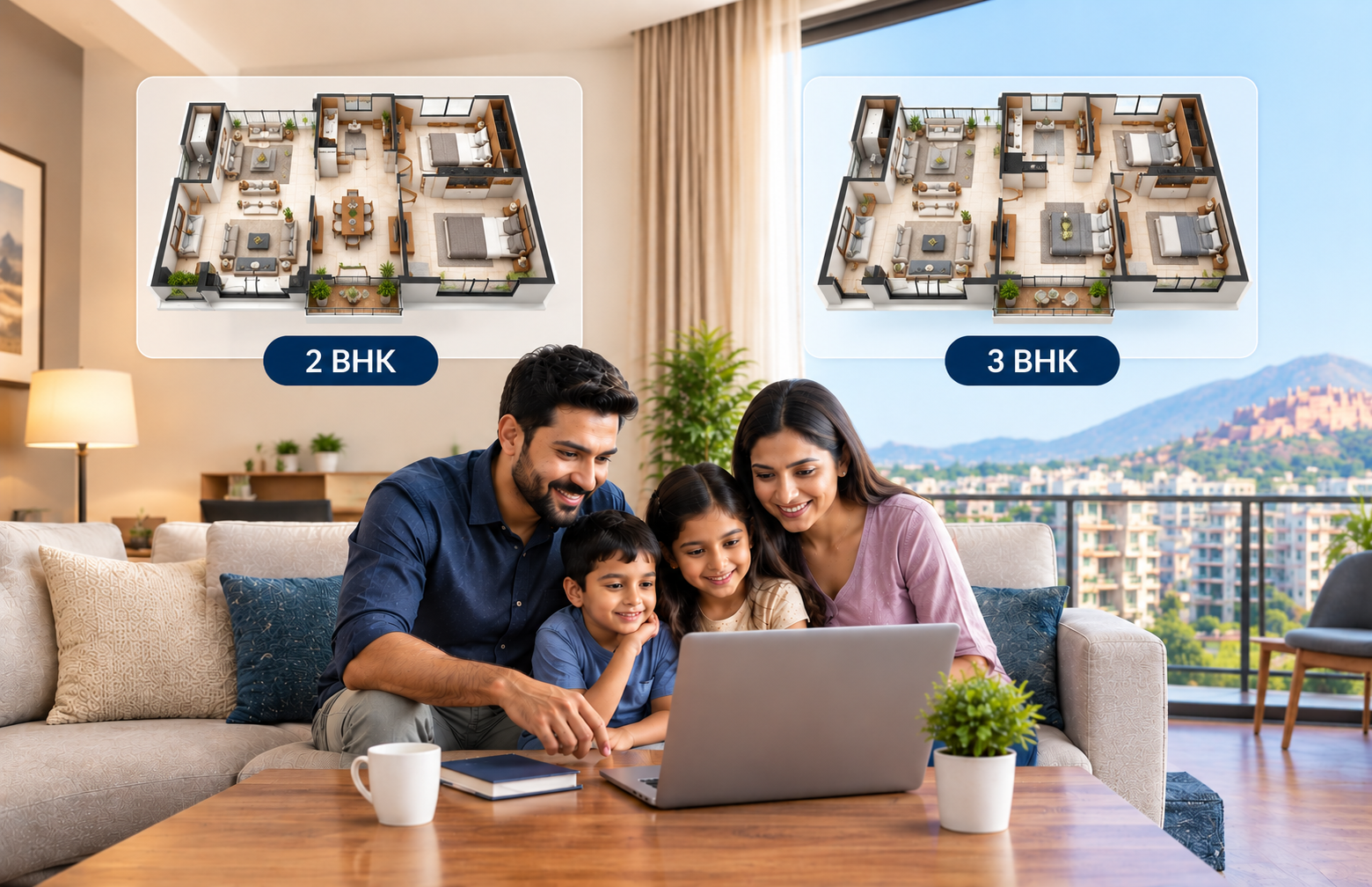
How Much Salary Do You Need to Buy a 3 BHK Flat in Jaipur?
Quick Summary
For illustration, if you buy a 3 BHK flat priced around ₹75 lakh to ₹1 crore and finance a substantial part of the purchase through a home loan, a monthly household income of roughly ₹1.2 lakh to ₹1.65 lakh may be a useful planning range when keeping the EMI around 40% of income. The actual salary required can be lower or higher depending on your down payment, interest rate, loan tenure, existing debts, and lender's eligibility criteria. Buyers should also keep separate funds for the down payment, stamp duty, registration, interiors, and other purchase-related expenses.
Table of Contents
Buying a 3 BHK flat is a major financial decision, especially when you are planning to purchase a home in a growing city like Jaipur. The question is not simply whether you can find a 3 BHK within your budget. You also need to know how much home loan you may need, what down payment you should prepare, how much EMI you can comfortably manage, and whether your monthly income can support the purchase without putting pressure on your finances.
If you are wondering about the salary to buy 3 BHK in Jaipur, there is no single salary figure that applies to every buyer. Your required income depends on the flat's price, down payment, loan amount, interest rate, loan tenure, existing EMIs, and other financial commitments. Understanding these factors can help you estimate a realistic budget before you start shortlisting properties.
What Determines the Salary to Buy 3 BHK in Jaipur?
The salary required to purchase a 3 BHK depends mainly on the relationship between the property price and the loan you need.
Banks and housing finance institutions generally assess factors such as income, existing liabilities, repayment capacity, credit profile, employment or business stability, and the requested loan amount. RBI's consumer guidance also notes that lenders assess repayment capacity using factors such as monthly disposable or surplus income, expenses, spouse's income, assets, liabilities, and income stability.
Therefore, two buyers looking at the same 3 BHK flat can have different loan eligibility.
For example, a buyer with a higher down payment and no existing loans may require a lower monthly income than someone who has a smaller down payment and several existing EMIs.
How Much Does a 3 BHK Flat Cost in Jaipur?
There is no single price for a 3 BHK flat across Jaipur. Prices vary significantly depending on location, project, carpet area, construction quality, amenities, floor, age of the property, and whether the property is new or resale.
Current listings demonstrate this variation. For example, Magicbricks data for April-June 2026 shows an average 3 BHK rate of around ₹5,910 per sq ft in Vaishali Nagar, while listings in areas such as Jagatpura and other Jaipur locations show different price levels. Individual properties can therefore fall into very different price brackets.
Pinkcity Housing's own portfolio also illustrates the importance of project-specific comparison. Pinkcity Palms in Vaishali Nagar Extension is a 3 BHK residential project with 80 units, while Lamba Heights III in Sanskar Vihar offers both 2 BHK and 3 BHK configurations.
This means your salary calculation should start with the actual price of the 3 BHK you want to purchase, rather than using one average Jaipur property price.
Example: Salary Required for a ₹75 Lakh 3 BHK
Let's take a ₹75 lakh 3 BHK as an illustrative example.
Suppose:
- Property price: ₹75 lakh
- Down payment: ₹18.75 lakh
- Home loan: ₹56.25 lakh
- Illustrative interest rate: 8.5% per year
- Loan tenure: 20 years
At these assumptions, the EMI would be approximately ₹48,800 per month.
If you use a planning benchmark of keeping home-loan EMI around 40% of monthly income, the required monthly income would be approximately ₹1.22 lakh.
This is only an illustration. A bank may calculate eligibility differently depending on your financial profile, and your actual interest rate and loan tenure can change the EMI.
Example: Salary Required for a ₹1 Crore 3 BHK
Now consider a ₹1 crore 3 BHK.
For an illustrative calculation:
- Property price: ₹1 crore
- Down payment: ₹25 lakh
- Home loan: ₹75 lakh
- Illustrative interest rate: 8.5% per year
- Loan tenure: 20 years
The estimated EMI would be approximately ₹65,100 per month.
Using the same 40% income planning benchmark, this would mean a monthly income of approximately ₹1.63 lakh.
This demonstrates why the question "How much salary do I need?" cannot be answered without first knowing the property's price.
A buyer purchasing a ₹75 lakh flat and a buyer purchasing a ₹1 crore flat can have very different income requirements even though both are buying a 3 BHK.
Salary to Buy 3 BHK in Jaipur: Illustrative Examples
Here is a simple way to understand the relationship between property price, loan and income.
For these examples, the calculation assumes a 25% down payment, an 8.5% illustrative interest rate, a 20-year tenure, and EMI at approximately 40% of monthly income.
- ₹75 lakh property: loan of ₹56.25 lakh, EMI around ₹48,800, indicative monthly income around ₹1.22 lakh
- ₹80 lakh property: loan of ₹60 lakh, EMI around ₹52,100, indicative monthly income around ₹1.30 lakh
- ₹90 lakh property: loan of ₹67.5 lakh, EMI around ₹58,600, indicative monthly income around ₹1.46 lakh
- ₹1 crore property: loan of ₹75 lakh, EMI around ₹65,100, indicative monthly income around ₹1.63 lakh
- ₹1.2 crore property: loan of ₹90 lakh, EMI around ₹78,100, indicative monthly income around ₹1.95 lakh
These are planning illustrations, not guaranteed bank eligibility figures. Your actual eligibility can vary based on income type, existing EMIs, credit history, loan tenure, interest rate, down payment and lender policies.
How Much Down Payment Do You Need for a 3 BHK?
Salary is only one part of the home-buying calculation. You also need enough savings for the upfront cost.
For higher-value housing loans, the RBI framework places limits on loan-to-value ratios. For housing loans above ₹75 lakh, the cited RBI framework has an LTV ceiling of 75%, which means buyers should not assume that the bank will finance the entire property price.
For example, if you are buying a ₹1 crore property and financing 75% through a home loan, the loan would be ₹75 lakh and you would need to arrange ₹25 lakh from your own funds.
But the down payment is not the only upfront requirement.
You should also budget for applicable:
- Stamp duty
- Registration charges
- Documentation and legal costs
- Interior work
- Furniture and appliances
- Parking or other project-specific charges, where applicable
- Moving expenses
- Initial maintenance or society-related payments, where applicable
RBI guidance also states that stamp duty, registration and documentation charges should not be included in the property cost for calculating the LTV ratio, so buyers should plan these expenses separately.
Should You Use Your Entire Savings for the Down Payment?
Not necessarily.
A common mistake is to use almost all available savings to make a large down payment and then have very little cash left for emergencies or other expenses.
Before purchasing a 3 BHK, consider keeping a separate emergency fund and accounting for the costs that will arise immediately after possession.
A slightly larger down payment can reduce the loan amount and EMI, but the right amount depends on your overall financial position.
The objective should be to make the purchase affordable without leaving your finances too tight after the purchase.
What If You Have an Existing EMI?
Existing debt can significantly affect your home-loan eligibility.
Suppose you already pay ₹20,000 per month towards a car loan or personal loan. If you then take a home loan with an EMI of ₹60,000, your total monthly debt obligations become ₹80,000.
This changes the affordability calculation considerably.
That is why two people with the same salary may receive different home-loan eligibility amounts.
Before applying, calculate:
Monthly income - existing EMIs - regular expenses = available income for a new home loan
The actual lender calculation can be more detailed, but this simple exercise gives you an initial understanding of your affordability.
Can a Couple's Combined Salary Help Buy a 3 BHK?
Yes, a joint home loan can allow eligible applicants to combine incomes for loan assessment, subject to the lender's rules.
For example, suppose one applicant earns ₹80,000 per month and the other earns ₹70,000. Their combined monthly income is ₹1.5 lakh.
This can create a different affordability picture compared with a single-income household earning ₹80,000.
However, a joint loan also means both applicants should understand the repayment responsibility, ownership structure, documentation, and other terms before proceeding.
If you are comparing different homes, it can also be useful to compare 3 BHK projects in Jaipur based on total cost, location, amenities, carpet area and long-term suitability rather than looking only at the advertised price.
How Loan Tenure Changes the Required Salary
Loan tenure can have a significant effect on EMI.
A longer tenure generally reduces the monthly EMI for the same loan amount, which can make the monthly repayment easier to manage. However, it can also increase the total interest paid over the life of the loan.
For example, a buyer may choose between a 20-year and 25-year loan depending on their income and financial goals.
Therefore, when calculating the salary to buy 3 BHK in Jaipur, do not look at the EMI in isolation. Consider both:
- Monthly EMI
- Total interest payable
A lower EMI is not automatically a lower-cost loan.
How Much Salary Is Comfortable for a 3 BHK?
There is a difference between being technically eligible for a loan and being financially comfortable with the loan.
Suppose your lender approves a home loan based on your income. That does not necessarily mean you should borrow the maximum amount available.
Your household also needs money for:
- Food and utilities
- Education
- Insurance
- Transportation
- Healthcare
- Investments
- Emergency savings
- Travel and lifestyle expenses
- Future financial goals
A comfortable home purchase should leave enough room for these requirements.
Instead of asking only, "What is the maximum loan I can get?", ask:
"What EMI can I comfortably pay every month without compromising my other financial goals?"
Factors That Can Increase or Reduce the Salary You Need
Several factors can change your required income.
Higher Down Payment
A higher down payment reduces the loan amount and therefore reduces the EMI.
Longer Loan Tenure
A longer tenure can reduce the monthly EMI, although it may increase total interest costs.
Lower Interest Rate
A lower interest rate can reduce the EMI for the same loan amount.
Existing Loans
Existing EMIs can reduce your available repayment capacity.
Strong Credit Profile
Your credit profile can influence your access to credit and the terms offered by a lender.
Co-Applicant Income
An eligible co-applicant's income may improve overall loan eligibility.
Property Price
This is one of the biggest factors. A ₹75 lakh property and a ₹1.2 crore property require very different financial planning.
How to Calculate Your Budget Before Searching for a 3 BHK
Before visiting projects, follow a simple process.
Step 1: Decide Your Maximum Comfortable EMI
Start with your monthly household income and existing obligations.
Do not automatically use the maximum EMI a lender says you can afford.
Step 2: Estimate Your Down Payment
Calculate how much money you can use without exhausting your emergency savings.
Step 3: Calculate the Loan Amount
Subtract your planned down payment from the property price you are considering.
Step 4: Compare Loan Tenures
Calculate the EMI for different tenures and compare the total interest payable.
Step 5: Add Purchase-Related Costs
Include registration, stamp duty, interiors and other applicable expenses.
Step 6: Shortlist Properties Within the Budget
Only after these calculations should you start comparing projects, locations and floor plans.
This approach can prevent you from becoming emotionally attached to a property that is outside your comfortable financial range.
Is a 3 BHK Affordable on a ₹1 Lakh Salary?
It depends on the property price, down payment and existing financial obligations.
A ₹1 lakh monthly salary does not automatically mean that a 3 BHK is unaffordable, but it may significantly limit the loan amount you can comfortably take.
For example, if you have substantial savings for the down payment and choose a relatively lower-priced 3 BHK, your required loan could be considerably smaller.
On the other hand, buying a premium 3 BHK with a large loan on the same salary could result in a high EMI relative to your monthly income.
The important factor is therefore not salary alone, but salary + down payment + existing debt + property price + loan terms.
Should You Buy a 3 BHK Based on Future Income?
It is better to base the purchase primarily on your current and reasonably predictable financial capacity rather than assuming that your salary will definitely increase in the future.
Income growth may happen, but career changes, economic conditions and personal circumstances can also affect future earnings.
If the current EMI is already difficult to manage, relying on future salary increases can create unnecessary financial pressure.
A more practical approach is to choose a property where the current repayment remains manageable while allowing room for future financial goals.
Final Thoughts
The answer to how much salary you need to buy a 3 BHK flat in Jaipur depends on more than your monthly income. Property price, down payment, loan amount, interest rate, tenure and existing financial commitments all affect how much you can comfortably borrow. A buyer considering a ₹75 lakh 3 BHK will have a very different financial requirement from someone looking at a ₹1 crore or ₹1.2 crore property.
Before choosing a home, calculate your comfortable EMI, estimate the required down payment, keep additional purchase expenses aside, and compare properties that fit your overall financial plan. A well-planned purchase is not simply about getting the largest home loan possible. It is about finding a 3 BHK that gives your family the space it needs while keeping the monthly repayment manageable over the long term.
Frequently Asked Questions
There is no fixed salary requirement. It depends on the property's price, down payment, loan amount, interest rate, tenure and existing financial obligations. For example, under an illustrative 8.5% rate, 20-year tenure and 25% down payment, a ₹75 lakh property could involve an EMI of around ₹48,800, while a ₹1 crore property could involve an EMI of around ₹65,100.
It may be possible depending on the property price, down payment, existing EMIs and lender assessment. A larger down payment and lower-priced property can reduce the required loan and EMI.
The required down payment depends on the property price and the loan-to-value allowed by the lender. Buyers should also keep separate funds for stamp duty, registration, interiors and other purchase-related expenses.
There is no universal EMI that is suitable for every buyer. As a personal budgeting approach, some buyers may use a portion of their monthly income as an EMI ceiling, but the right amount depends on household expenses, existing debt, savings and financial goals.
Eligible applicants can generally apply jointly and lenders may consider the co-applicant's income, subject to their policies and eligibility requirements. The exact loan amount depends on the applicants' overall financial profiles.